
WHAT WE DO
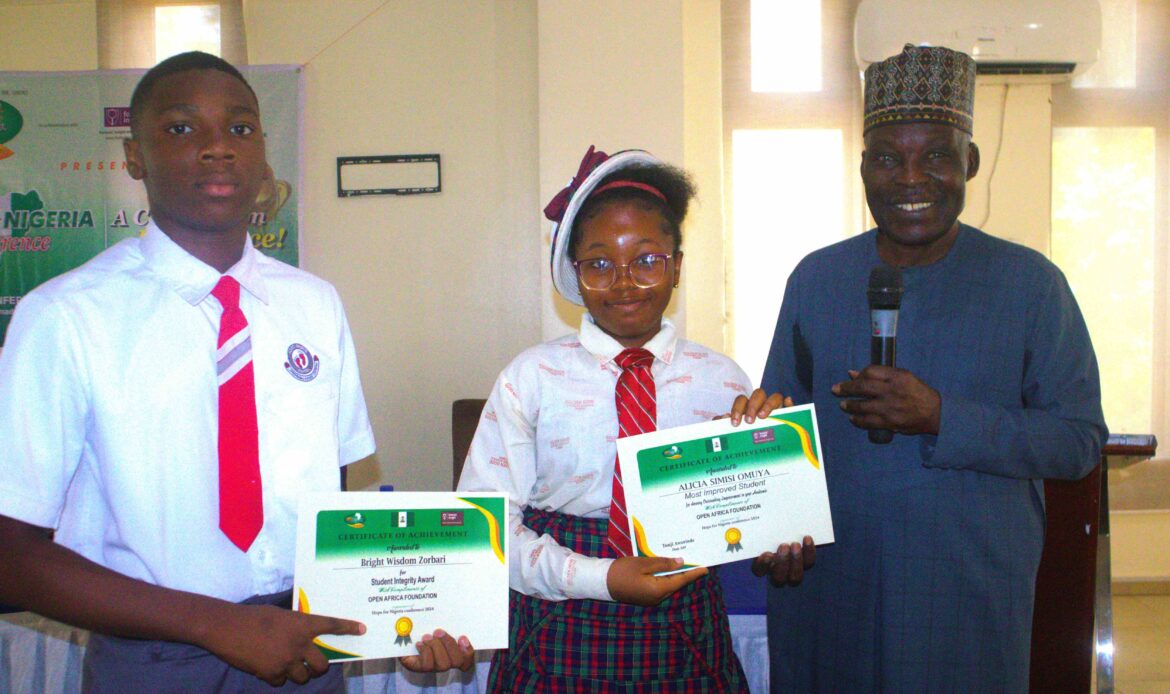
HOPE FOR NIGERIA CONFERENCE is conference organised for secondary schools’ students in the FCT. The conference aims at –
- Campaigning and advocating against child abuse, child poverty etc
- Empowering young people by supporting and contributing to education
- Promoting integrity, excellence, cultural and intellectual values
- Supporting and equipping secondary schools by provision of learning enhancing equipment and facilities as far as possible.
- Board of Trustees aims at replicating conference in each of the six geopolitical zones of Nigerian within six years
Campaigners and advocates
We are campaigners and advocates for child’s rights to life, health and
education and for the wellbeing of the child (UN Convention on the rights of
the Child & Child’s Right Act 2003)
Education, Education, Education’
‘In Nigeria, more than 10 million
children are not in school even though primary education is free and
compulsory’ (UNESCO). All children, no matter where they live or what their
circumstances, have the right to quality education! We demand policies and
resources to get ‘out of school children’ from the streets into classrooms!
Citizens’ Rights
Supporting children and the young, by engagement, education and empowerment, promotion of citizens’ rights, and holding elected representatives and public servants to account.
Innovative project initiatives
‘We are guilty of many errors and many faults, but our worst crime is
abandoning the children, neglecting the fountain of life. Many of the things we
need could wait – the child cannot’ (Lucia Alcayaga)
VISION
The Africa where integrity, accountability and transparency is
enthroned.
The Africa where the African is VALUED by the content of his/her
character and NOT by wealth, family, social and political affiliations.
MISSION
I’ve spoken of the shining city but I don’t know if I would be able to communicate what I saw, but in my vision, it was a proud city built on rocks, stronger than the oceans. God blessed and teaming with people of all kinds; people living in harmony and peace, a city that hummed with commerce, constructed on the foundation of integrity, accountability and the rule of law. And if there had to be city walls, the walls had doors and opened to every citizen. That’s how I saw it, and see it still!
The International Convention on the Rights of the Child (CRC) was adopted November 20, 1989 by the UN General Assembly. Nigeria adopted the Child rights Act in 2003 to domesticate the CRC.
Statistics on the well-being of Nigerian Children, as evidenced by research and media coverage, are very deplorable. An estimated 13.5 million are out of school! Nigeria is thus caped with one more ignominy, among others, as harbouring the largest number of out-of-school children in the world (BBC report 2017) (Punch Newspaper 19/06/2019)
Our campaign and advocacy are altogether, expression of anger and despair! Anger and despair, at the state of our nation; the grand and eye-watering corruption, the lawlessness and impunity; poverty and insecurity; brought upon our children by criminaloids in public and private spaces of our nation, earning us the reputation and the ignominy of ‘the poverty capital of the world’. And consequently, the neglect of our children and our young people!
We’re here advocating and calling on state and non state actors and institutions and other stakeholders, that the status quo is no longer acceptable; and demand therefore the following:
10 POINTS AGENDA FOR NIGERIAN CHILDREN
1. Free prenatal/postnatal medical provisions for expectant mothers
2. Free and compulsory education for boys and girls, up to age 16
3 Free school meals for school children up to age 16
(One in three Nigerian children experiences severe child food poverty (UNICEF 2024)
4 Free textbooks/learning resources for children up to age 16
5. Learning should be in built up classrooms, not under trees or
makeshift structures
6. Curbing grand corruption and wastes to curb multidimensional child poverty
(54% of Nigerian children are multidimensional poor – UNICEF 2024)
7. Legislation and eradication Child labour
(about 14 million children aged 5-14 years in child labour – UNICEF 2022)
8. Child rights – Enforcement of Rights of the Child to life, dignity,
education, health, protection from abuse, exploitation, and discrimination
(1989 Constitution, Chap 4; Child’s Rights Act 2003; Art. 7, UN Rights of the Child)
9. Federal & State governments must address and urgently, the more
than 13.5 million out of school children back to school
10. Children must school without fearing kidnapping and murderous gangs of insurgents and terrorists
‘We are guilty of many errors and many faults, but our worst crime is abandoning the
children, neglecting the fountain of life. Many of the things we need could wait – the child cannot’ (Lucia Alcayaga)
We’re here advocating and calling on the state, institutions and other stakeholders, that the status quo is no longer acceptable; and demand therefore the following 10 points agenda for the welfare of our children and young people
HOPE FOR NIGERIA CONFERENCE IS ORGANISED FOR SECONDARY SCHOOLS’ STUDENTS IN THE FCT